
The Starfish, the Spider, and the Octopus
By Zvi Schreiber · December 2025 · 15 min read
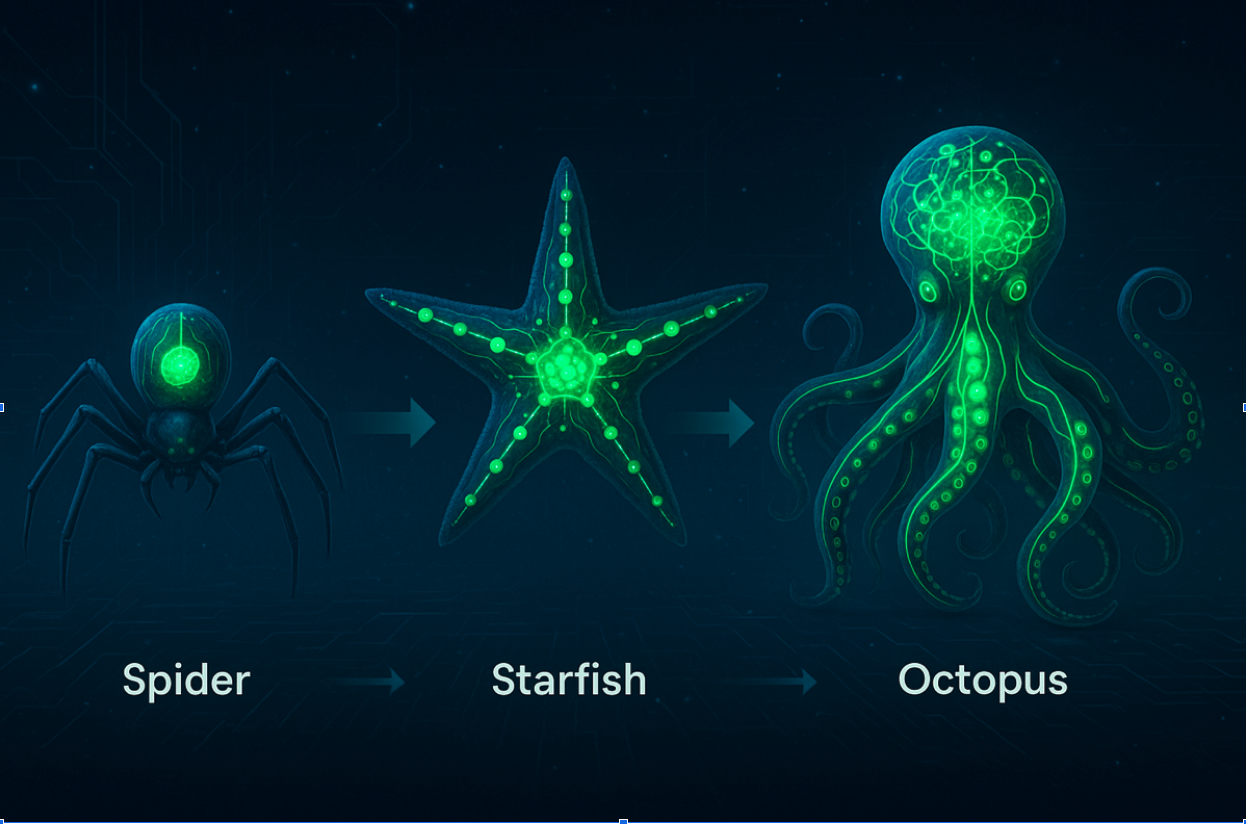
Why AI Unlocks a New Organizational Species
A few years ago, I sat in a conference room at Freightos, the freight technology company I lead, rolling out OKRs for the second time. The first attempt had failed — not because we implemented them poorly, but because we implemented them well. Our teams had dutifully narrowed their focus to three to five objectives, defined measurable key results, and cascaded goals from company to department to individual. Then reality hit: the things we’d decided not to focus on turned out to matter. Customers needed features we’d deprioritized. Strategic initiatives we’d deferred became urgent. The framework had forced us to abandon work that was genuinely important.
So there we were, trying again, and I watched the same ritual unfold: talented people agonizing over which important things to cut. We weren’t debating what mattered — everything on the list mattered. We were rationing attention, deciding which strategic priorities to starve so that others could be fed.
That’s when it struck me: the entire system is built around the assumption that attention is scarce and must be rationed. OKRs don’t help you do more; they help you do less, more deliberately. And we were spending enormous energy — weeks of leadership time — figuring out what not to do.
I was describing a feature, not a bug. OKRs exist precisely because humans can only hold a handful of priorities in their heads at once. Andy Grove designed them at Intel in the 1970s for exactly this reason — to force a sprawling semiconductor company to focus. John Doerr brought them to Google in 1999 and later evangelized them in his bestseller Measure What Matters. The system spread because it solved a real problem: human cognitive bandwidth is limited, so we need frameworks to allocate it wisely.
But sitting in that conference room, watching talented people agonize over which important things to deprioritize, I started to wonder: What if this constraint weren’t permanent? What if the solution wasn’t better prioritization but the elimination of the need to prioritize?
That question has taken on new urgency.
Nearly two decades ago, Ori Brafman and Rod Beckstrom gave us a powerful lens for understanding organizations in their 2006 book The Starfish and the Spider. Their insight was elegant: traditional hierarchical organizations are like spiders — cut off the head, and they die. But decentralized organizations like Alcoholics Anonymous, Wikipedia, and the Apache tribe are like starfish — cut off a leg, and they regenerate. The internet age, they argued, favored the starfish.
That framework has shaped how a generation of leaders thinks about organizational design. But here’s what I’ve come to realize: the starfish versus spider choice is a false dichotomy. Both are adaptations to the same underlying constraint — the limited bandwidth of human cognition. The spider concentrates scarce attention at the top. The starfish distributes scarce attention to the edges. Neither eliminates the scarcity.
OKRs are a spider tool. So is the org chart. So is the entire apparatus of management we’ve built over 150 years: the C-suite, the quarterly planning cycle, the executive team meeting, the cascading goals, the annual review. All of it — every framework, every ritual, every box on the organization chart — exists because human attention is scarce and must be carefully allocated.
What happens when that constraint disappears?
The answer isn’t a better spider or a faster starfish. It’s an entirely new organizational species. Call it the octopus.
The Spider’s Bargain
To understand why AI changes everything, we need to first understand why the spider exists at all.
The hierarchical corporation emerged in the late 19th century to solve a specific problem: how do you coordinate thousands of people toward a unified purpose when no single human can hold more than a handful of relationships and priorities in their head? The answer was to distribute cognition across specialized roles, connected by reporting lines and standardized processes.
Consider what the C-suite actually is. A CEO cannot simultaneously master finance, marketing, operations, technology, and human resources — not because these domains are inherently incompatible, but because one human brain doesn’t have enough hours or neurons. So we invented the CFO, CMO, COO, CTO, and CHRO. Each executive develops deep expertise in one domain and maintains a mental model of their function. The CEO’s job becomes integrating these perspectives and making tradeoffs between them.
This is ingenious. It’s also phenomenally expensive.
OKRs emerged from the same logic. Grove’s insight at Intel was that if everyone pursues their own priorities, the organization fragments. But if the CEO tries to specify everyone’s work, the organization calcifies. OKRs thread the needle: the top sets objectives, teams define how to achieve them, and the key results create accountability without micromanagement.
But notice what OKRs assume. They assume people need help focusing because attention is scarce. They assume quarterly cycles because humans need deadlines to drive action. They assume three to five objectives because that’s roughly what human working memory can hold. They assume cascading because information flows imperfectly through hierarchies. The entire system is a sophisticated workaround for cognitive limitations.
The costs of these workarounds are so familiar we’ve stopped seeing them. Every time a decision requires input from multiple executives, we pay coordination costs — meetings, memos, alignment sessions. Every time information passes up or down the hierarchy, we lose fidelity. Every time we force-rank priorities, we abandon important work that didn’t make the cut. Every time executives disagree, we pay political costs — turf battles, budget wars, strategic compromises that optimize for internal peace rather than external results.
A study by Bain & Company found that the average large company loses more than 20% of its productive capacity to “organizational drag” — the hidden tax of coordinating across silos and hierarchies1. For a Fortune 500 company, that’s billions of dollars annually.
We accept these costs because we have no alternative. The spider — and its attendant tools like OKRs — is a bargain: you trade efficiency for coordination, fluidity for structure, breadth for focus. For the industrial era, when stability mattered more than adaptation, this bargain made sense.
But it was always a compromise, never an ideal.
The Starfish’s Promise and Limits
The internet seemed to offer a way out. Brafman and Beckstrom’s starfish organizations — decentralized, leaderless, resilient — captured the imagination of a generation of founders and management theorists.
The appeal is obvious. Starfish organizations don’t have the spider’s single point of failure. They can adapt faster because they don’t wait for central approval. They can scale without the coordination costs that make large hierarchies sluggish. Wikipedia produces more content than any encyclopedia in history with no editorial hierarchy. Bitcoin processes billions in transactions and was not slowed down by the disappearance of its anonymous founder.
But starfish have their own limitations, and they’ve become clearer as the model has matured.
Starfish organizations excel at tasks that can be decomposed into independent units — an encyclopedia article, a cryptocurrency transaction, a regional AA meeting. They struggle with tasks that require unified strategy executed across multiple fronts. There’s a reason no one has built a starfish pharmaceutical company or a starfish aircraft manufacturer. Complex products require too much interdependence; true strategic coherence requires something the starfish deliberately eschews — a unified mind.
The starfish traded the spider’s coordination problem for a coherence problem. You get speed and resilience but sacrifice the ability to execute complex, multi-step strategies that require different parts of the organization to move in precise synchrony.
This is why, despite decades of enthusiasm for “flat” organizations and “decentralized” structures, the spider never went away. Most successful companies ended up as hybrids — starfish rhetoric with spider reality, or spider structures with a sprinkling of starfish-style autonomous teams. The dream of true decentralization kept running into the hard wall of strategic coherence.
The spider and the starfish aren’t opposites. They’re two different compromises with the same underlying constraint: human attention is scarce, so you either concentrate it (spider) or distribute it (starfish). Neither eliminates the scarcity. Both merely allocate it.
Enter the Octopus
Enter the octopus, one of the most remarkable organisms on Earth. It has a central brain with 500 million neurons — comparable to a dog — but here’s what makes it unique: it is not a physically centralized brain, two-thirds of those neurons are distributed throughout its eight arms. Each arm can taste, touch, and make decisions semi-independently. An octopus can solve a puzzle with one arm while another arm explores a crevice and a third opens a jar.
Yet it remains one animal, one mind. The arms don’t vote on what to do. They don’t negotiate or coordinate through meetings. The octopus doesn’t experience internal politics between its left and right sides. It simply thinks with its whole body, a unified intelligence that is simultaneously everywhere.
This is the organizational model that AI will start to make possible.
The fundamental insight is this: the spider, the starfish, OKRs, and org charts all assume that executive attention is scarce. The spider concentrates scarce attention at the top. The starfish distributes scarce attention to the edges. OKRs ration scarce attention to the highest priorities. But what if executive attention were no longer scarce?
A well-designed AI system can maintain awareness of financial metrics, customer sentiment, operational status, competitive dynamics, and employee engagement simultaneously — not by distributing these concerns across separate minds that must then coordinate, but by holding them in a single integrated model. It can think through the CFO lens, CMO lens, and COO lens concurrently, not sequentially. It doesn’t need quarterly planning cycles because it’s continuously optimizing. It doesn’t need executive team meetings because there’s no one to align — it’s already aligned with itself. It doesn’t need OKRs because it doesn’t need help focusing — it can focus on everything at once.
This isn’t automation of the spider. That would be using AI to make each executive function faster while preserving the basic architecture of specialized roles coordinated through hierarchy. Companies are already doing this — AI-assisted financial planning, AI-powered marketing analytics — but it merely creates faster spiders. The coordination costs, the information loss, the political friction, the need for OKRs to force focus — all remain.
The octopus model is more radical: it asks why we have separate executive functions at all. It asks why we need frameworks to ration attention when attention is no longer scarce. It asks why we need periodic reviews — monthly, quarterly and annual — if we can optimize continually.
Anatomy of the Octopus Organization
The future AI-powered octopus organization has four defining characteristics, each representing a fundamental break from both spider and starfish models.
The distributed brain. An octopus has a unified mind that extends throughout its body. Similarly, an octopus organization has unified executive intelligence that isn’t localized to a corner office or even a C-suite floor. The executive function is ambient — present wherever and whenever decisions need to be made.
In practice, this means an AI system that simultaneously monitors sales pipeline health, recruitment needs, cash flow, customer satisfaction scores, product development velocity, and market conditions — not as separate dashboards reviewed in weekly meetings, but as an integrated model that continually optimizes across all dimensions. When a key customer’s satisfaction drops, the system doesn’t file a ticket for the customer success team and wait for the weekly review. It adjusts the product roadmap, prepares the account manager, and considers the financial implications — all simultaneously, because all of these concerns exist in one mind.
The semi-autonomous arms. Each arm of an octopus has its own neural cluster — enough intelligence to handle routine operations independently while referring novel situations to the central brain. In an octopus organization, frontline operations have AI agents embedded that handle routine decisions without escalation.
Consider a customer support interaction. In a spider organization, the support agent follows a script, escalates to a team lead if needed, who escalates to a VP if it’s a big enough issue — each handoff adding latency and information loss. In an octopus organization, the AI support agent has full context: this customer’s purchase history, their lifetime value, the current inventory situation, the company’s strategic priorities, and the authority to make decisions within defined parameters. It doesn’t need to escalate to get discount approval because it already knows the financial impact, the customer’s importance, and the company’s margin targets.
The unified nervous system. An octopus doesn’t have separate systems for vision, touch, and taste that need to be integrated — it has one continuous nervous system. Similarly, an octopus organization doesn’t have separate databases for sales, marketing, operations, and finance that need to be integrated — it has one unified data model.
This is perhaps the most underestimated requirement. Most organizations today suffer from data fragmentation that mirrors their organizational fragmentation. The CRM doesn’t talk to the ERP, which doesn’t talk to the HRIS, which doesn’t talk to the project management tool. Each “arm” of the organization has its own data silo, and enormous effort goes into building integrations, data warehouses, and dashboards that attempt to create a unified view after the fact.
An octopus organization starts with unified data. Every arm accesses the same nervous system. The AI can think across domains because the data isn’t siloed across domains.
The ability to reshape. An octopus has no skeleton. It can squeeze through any opening, change color and texture, and physically reshape itself to match its environment. An octopus organization has no rigid structure — no fixed org chart, no immutable processes, no “the way we’ve always done it.”
This is where the octopus model most dramatically departs from the spider. A spider organization can reorganize, but it’s expensive and disruptive — the infamous “reorg” that happens every few years and takes months to settle. An octopus organization reorganizes continuously, reallocating intelligence and resources to whatever the situation demands.
What Dies, What Survives
If the octopus model is so superior, what happens to the structures we’ve built over 150 years of spider organization?
What dies:
The C-suite as we know it. If one intelligence can think through financial, operational, marketing, and technical lenses simultaneously, organizing around these functions creates overhead rather than value.
The executive team meeting. If there’s no need to align separate minds, there’s no need to synchronize calendars and debate priorities in conference rooms.
OKRs and quarterly planning. When attention isn’t scarce, you don’t need frameworks to ration it. When optimization is continuous, you don’t need artificial quarterly boundaries.
Internal politics. Budget battles, turf wars, and strategic compromises that balance internal power rather than external reality all depend on having multiple actors with divergent interests.
What survives:
Human governance. Octopus organizations still need humans to set the constraints — the values, the boundaries, the ultimate purposes. The AI executive operates within a constitution defined by humans. Boards remain essential.
External relationships. Some stakeholders simply want to deal with humans. Key investors, major partners, regulators — these relationships may require a human face indefinitely.
Escalation and override. When the AI is uncertain, when stakes are existential, when the situation is genuinely novel — humans must be able to step in.
The human role in an octopus organization shifts from managing to governing, from operating to overseeing, from rowing to steering. Fewer humans are needed, but those who remain are more critical, not less. They’re the captains, not the crew.
The Transition Challenge
Here’s what makes this transition treacherous: you cannot get an octopus by optimizing a spider.
Most organizations implementing AI today are doing precisely this. They add AI tools to existing functional roles — AI for the finance team, AI for the marketing team, AI for customer service. Each function gets faster. But the fundamental architecture remains unchanged: specialized roles coordinating through hierarchy, attention rationed through OKRs.
This creates what we might call the “AI-enhanced spider” — quicker in each leg but still limited by its spider structure. The coordination costs remain. The information loss between functions persists. The political friction continues. You’ve made each executive 20% more productive while preserving the 20% organizational drag.
The path to octopus requires rethinking the basic architecture, not accelerating the existing one. It means asking: “If we were designing this organization today, with AI capable of unified executive cognition, would we create a CFO role? Would we implement OKRs? Would we have quarterly planning?” For most companies, the honest answer is no.
This is why the first true octopus organizations are more likely to be startups than transformations. It’s easier to build new than to renovate.
The Choice Ahead
I think back to that conference room at Freightos, watching us agonize over which priorities to prioritize and which to abandon. The OKR framework was working exactly as designed — forcing focus, creating alignment, rationing our scarce attention. Andy Grove would have been proud.
But Grove designed OKRs in the 1970s for an organization of humans. The constraint he was solving — limited cognitive bandwidth — was real and permanent, or so it seemed. Resistance was futile; you simply had to allocate scarce attention wisely.
That constraint is starting to melt away with each new generation of AI.
The question for leaders isn’t whether AI will transform organizations — it will — but whether you’ll use AI to build a faster spider or something genuinely new. The first path is easy and incremental: add AI tools to existing roles, keep your org chart intact, continue your quarterly OKR cycles. The second path requires reimagining the fundamental assumptions of organizational design.
Brafman and Beckstrom were right that the starfish and spider represent fundamentally different organizational philosophies. But they were writing in an era when both models were constrained by the same underlying scarcity. That constraint is lifting.
The organizations that thrive in the AI era won’t be the ones with the best AI tools bolted onto traditional structures. They’ll be the ones that asked, from the beginning, what organization would look like if unified intelligence were abundant rather than scarce.
They’ll be octopi.
The starfish taught us about decentralization. The spider taught us about hierarchy. The octopus will teach us about coherence — unified intelligence that is simultaneously everywhere, with no skeleton to constrain its shape and no need to ration its attention.
The only question is whether you’ll learn the lesson as a founder or an observer.
Zvi Schreiber is the CEO of Freightos, a digital freight platform. He has spent two decades building technology companies and recently too much time thinking about organizational design for the AI era.